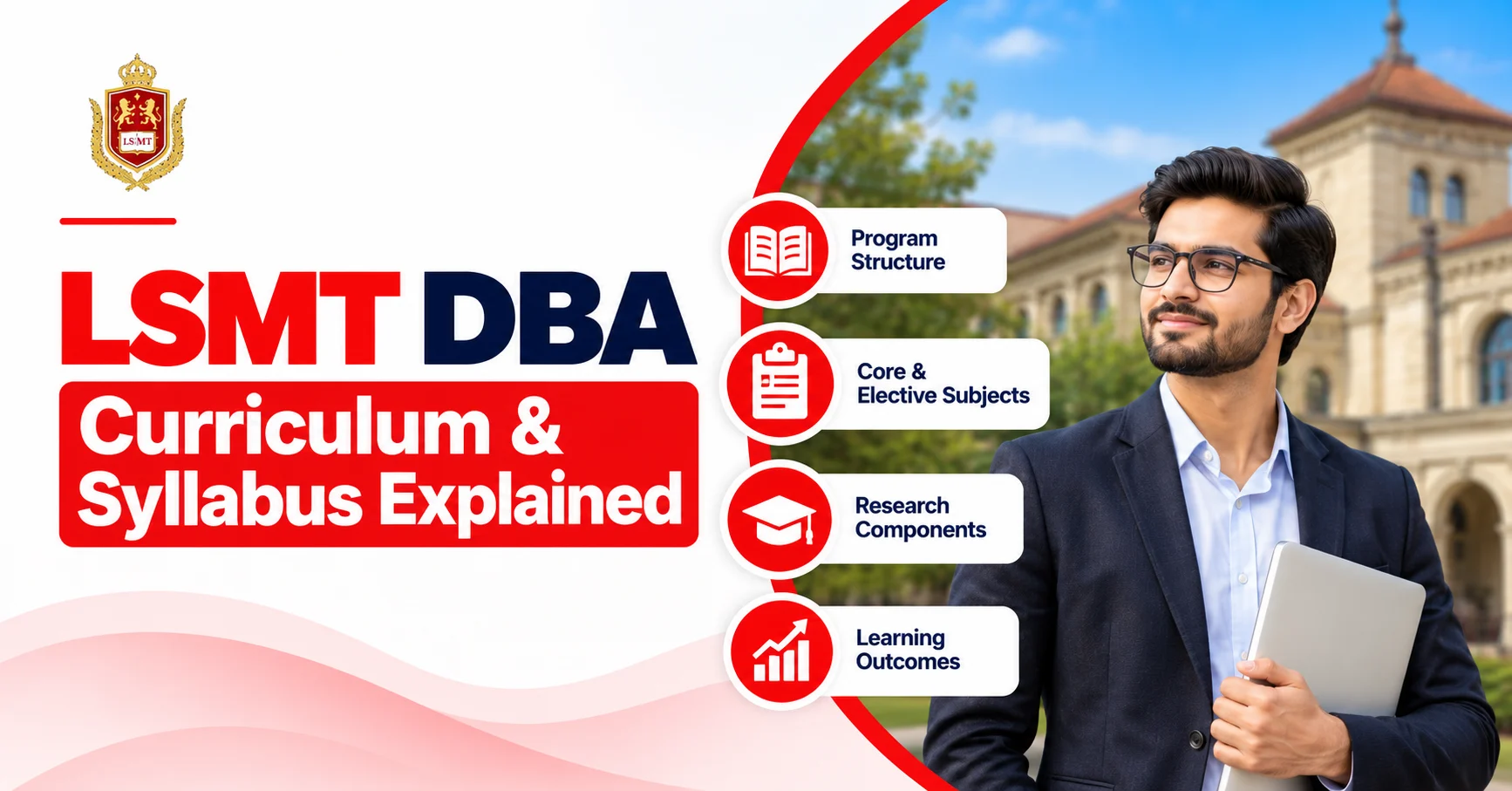
The Doctor of Business Administration programme offered by the London School of Management and Technology, commonly known as LSMT, is designed for professionals who want to develop advanced management knowledge, leadership capabilities, and applied business research skills.
The LSMT DBA curriculum combines business management subjects with research methodology and a substantial dissertation. Students explore strategic financial management, marketing, human resource management, organisational change, entrepreneurship, operations, globalisation, and corporate governance.
For professionals considering the programme in 2026, understanding the syllabus can help them identify the subjects they will study and how these subjects connect with their career goals. This guide explains the LSMT DBA curriculum year by year, including course titles, credit structure, research requirements, and potential applications in the workplace.
LSMT DBA Curriculum 2026: Programme Overview
| Particulars | Details |
|---|---|
| Institution | London School of Management and Technology |
| Programme | Doctor of Business Administration |
| Study Mode | Online programme advertised |
| Published Duration | 3 years |
| Total Programme Credits | 180 ECTS |
| Year 1 | Research foundations and core business subjects |
| Year 2 | Strategy, leadership, operations, and innovation |
| Year 3 | Research and dissertation |
| Main Learning Areas | Finance, marketing, HR, strategy, operations, and research |
| Research Component | Advanced research methods and doctoral dissertation |
The published syllabus describes a three-year, 180-ECTS programme. Students should confirm the latest curriculum, delivery arrangements, assessment rules, and expected completion timeline for their particular intake.
LSMT DBA Syllabus: Year-Wise Structure
The curriculum is divided into three academic years. The first year develops business knowledge and research foundations, the second expands strategic and operational management capabilities, and the third focuses on dissertation research.
| Academic Year | Main Focus | Total Credits |
|---|---|---|
| Year 1 | Research methods and core management subjects | 60 ECTS |
| Year 2 | Strategic management, leadership, operations, and innovation | 60 ECTS |
| Year 3 | Research and Dissertation | 60 ECTS |
| Total | Complete DBA Programme | 180 ECTS |
Year 1: LSMT DBA Subjects
The first year combines research preparation with core business disciplines. These subjects help students understand how organisations make financial, marketing, and human resource decisions while preparing them to investigate business challenges systematically.
1. Developing Research Capability
Developing Research Capability introduces the principles of academic and applied business research. Students learn how to identify management problems, review existing research, and develop questions that can be investigated through a structured research process.
The subject helps students understand how research can support evidence-based management decisions.
Key learning areas include:
- Identifying business research problems
- Reviewing academic literature
- Developing research questions and objectives
- Evaluating existing evidence
- Identifying research gaps
- Connecting research with practical business challenges
This module provides an important foundation for the dissertation that students complete later in the programme.
2. Advanced Research Design and Methodologies
Advanced Research Design and Methodologies focuses on selecting appropriate research methods, collecting information, analysing data, and interpreting findings.
Students examine how different research approaches can be used to investigate organisational and management issues.
Key learning areas include:
- Research design and methodology
- Quantitative and qualitative research
- Data collection techniques
- Research instruments and sampling
- Data analysis and interpretation
- Research validity and reliability
- Evaluating research findings
- Academic research presentation
The module is particularly important for professionals who want to develop a credible dissertation based on a real business problem.
3. Strategic Human Resource Management
Strategic Human Resource Management examines how organisations manage people to support business objectives. Rather than focusing only on recruitment and administration, the subject explores how HR policies influence organisational performance.
Key learning areas include:
- Strategic workforce planning
- Talent acquisition and retention
- Employee development
- Performance management
- Leadership and employee engagement
- Organisational culture
- HR strategy and business performance
This module may be relevant to managers, HR professionals, business owners, and consultants interested in improving workforce effectiveness.
4. Strategic Financial Management
Strategic Financial Management focuses on how financial decisions influence organisational growth, profitability, and long-term stability.
Students explore the relationship between financial planning and wider business strategy.
Key learning areas include:
- Financial planning and budgeting
- Investment decisions
- Financial performance analysis
- Capital allocation
- Risk assessment
- Financial resource management
- Strategic financial decision-making
The subject can help professionals understand the financial implications of business plans and evaluate whether strategic initiatives are financially sustainable.
5. Strategic Marketing
Strategic Marketing examines how organisations identify customers, position their products or services, and develop competitive marketing strategies.
The subject considers marketing as a long-term business function connected with customer relationships and organisational growth.
Key learning areas include:
- Market research and segmentation
- Customer behaviour
- Product and service development
- Pricing strategies
- Promotion and distribution
- Brand positioning
- Customer relationship management
- International marketing considerations
This module may benefit marketing managers, entrepreneurs, business development professionals, and consultants who want to understand how marketing decisions support business performance.
Year 2: LSMT DBA Subjects
The second year focuses on leadership, organisational change, project management, operations, entrepreneurship, and corporate governance. These subjects help students connect business strategy with implementation and organisational performance.
1. Managing Strategic Change
Managing Strategic Change examines how organisations respond to changing markets, technologies, competitive pressures, and internal business challenges.
Students explore how leaders plan and implement change while managing resistance and maintaining organisational performance.
Key learning areas include:
- Organisational change management
- Strategic transformation
- Leadership during change
- Employee resistance and engagement
- Stakeholder communication
- Change implementation
- Evaluating transformation outcomes
The subject may be useful for executives and managers responsible for restructuring, digital transformation, or organisational improvement.
2. Project Development, Planning and Management
Project Development, Planning and Management focuses on turning business objectives into structured projects. It examines how projects are planned, managed, evaluated, and aligned with organisational priorities.
Key learning areas include:
- Project planning and scope definition
- Project objectives and deliverables
- Resource and schedule management
- Risk identification and mitigation
- Stakeholder coordination
- Project monitoring and evaluation
- Managing research projects
The module can help professionals approach complex projects with a more systematic management framework.
3. Developing Strategic Management and Leadership Potential
This module examines how leadership and strategic management work together to influence organisational performance.
Students explore how leaders evaluate business environments, establish priorities, manage resources, and guide teams towards long-term objectives.
Key learning areas include:
- Strategic management principles
- Leadership approaches
- Strategic analysis and decision-making
- Organisational leadership
- Managing teams and stakeholders
- Leadership in changing environments
- Aligning strategy with organisational goals
This subject may suit experienced professionals who want to strengthen their strategic thinking and leadership capabilities.
4. Supply Chain and Operations Management
Supply Chain and Operations Management explores how organisations manage production, procurement, logistics, suppliers, and business processes.
The module focuses on how operational decisions affect efficiency, quality, cost, and customer satisfaction.
Key learning areas include:
- Supply chain planning
- Procurement and supplier management
- Inventory and logistics
- Process improvement
- Operations strategy
- Quality and productivity
- Supply chain risks
- Coordinating business operations
This module may be relevant to operations managers, manufacturing professionals, logistics specialists, and business consultants.
5. Entrepreneurship and Innovation
Entrepreneurship and Innovation examines how businesses identify opportunities, develop new ideas, and build or improve products, services, and business models.
Students explore how innovation can contribute to competitiveness and sustainable growth.
Key learning areas include:
- Entrepreneurial thinking
- Opportunity identification
- Business model development
- Innovation strategy
- New product and service development
- Managing innovation
- Business growth and expansion
- Evaluating entrepreneurial opportunities
This module may benefit business owners, startup founders, innovation managers, and professionals involved in new business initiatives.
6. Globalisation and Corporate Governance
Globalisation and Corporate Governance explores how international business activity influences organisational strategy, accountability, and management practices.
Students examine how businesses operate across different markets while addressing governance, ethical, and regulatory considerations.
Key learning areas include:
- Global business environments
- International expansion
- Corporate governance principles
- Business ethics
- Accountability and transparency
- Managing multinational operations
- Stakeholder relationships
- Governance challenges in international business
The module may be valuable for executives, consultants, entrepreneurs, and professionals working with international organisations.
Year 3: LSMT DBA Research and Dissertation
The third year is dedicated to the Research and Dissertation module, which carries 60 ECTS in the published curriculum.
The dissertation gives students an opportunity to investigate a specific business or management problem through structured research. It connects the knowledge developed in earlier modules with an in-depth examination of a real organisational challenge.
Research Topic Selection
Students identify a business issue that is relevant to their professional background or research interests. The topic should be sufficiently focused to support meaningful investigation.
Potential research areas include:
- Leadership effectiveness and organisational performance
- Strategic financial decision-making
- Employee engagement and talent retention
- Digital transformation in business
- Supply chain resilience
- Innovation and entrepreneurship
- International business strategy
- Marketing performance and customer behaviour
The suitability of a topic depends on the programme’s research requirements and available academic supervision.
Research Proposal Development
Students develop a proposal that explains the research problem, objectives, relevant literature, and intended methodology.
A well-structured proposal helps establish the purpose and scope of the dissertation.
Literature Review
The literature review examines existing research relevant to the selected topic. It helps students understand established theories, evaluate previous findings, and identify areas that require further investigation.
Research Methodology and Data Collection
Students select suitable methods for collecting and analysing information. Depending on the research question, this may involve quantitative data, qualitative interviews, case studies, surveys, or other appropriate methods.
The chosen approach must be suitable for the research objectives and follow applicable ethical requirements.
Data Analysis and Findings
Students analyse the collected information and explain what the findings reveal about the business problem.
The objective is to develop conclusions supported by evidence rather than relying solely on personal opinion.
Dissertation Writing and Submission
The final dissertation presents the research problem, literature review, methodology, analysis, findings, conclusions, and recommendations.
Students should confirm the university’s current rules for dissertation supervision, submission, assessment, and any oral defence requirement.
LSMT DBA Curriculum Summary
The following table provides a consolidated view of the published modules.
| Year | Subject | ECTS |
|---|---|---|
| 1 | Developing Research Capability | 10 |
| 1 | Advanced Research Design and Methodologies | 20 |
| 1 | Strategic Human Resource Management | 10 |
| 1 | Strategic Financial Management | 10 |
| 1 | Strategic Marketing | 10 |
| 2 | Managing Strategic Change | 10 |
| 2 | Project Development, Planning and Management | 10 |
| 2 | Developing Strategic Management and Leadership Potential | 10 |
| 2 | Supply Chain and Operations Management | 10 |
| 2 | Entrepreneurship and Innovation | 10 |
| 2 | Globalisation and Corporate Governance | 10 |
| 3 | Research and Dissertation | 60 |
| Total | 180 ECTS |
Course titles and module arrangements should be checked against the latest official programme documentation before enrolment, as published materials may be updated.
What Skills Can Students Develop Through the LSMT DBA?
The LSMT DBA syllabus combines management education with applied research. The programme’s potential learning outcomes include the following capabilities.
Strategic Decision-Making
Students examine how organisations develop strategies, allocate resources, respond to competition, and evaluate business opportunities.
Leadership and Organisational Development
The leadership and HR subjects help students explore workforce management, organisational behaviour, and the challenges involved in implementing change.
Financial and Marketing Analysis
Financial management and strategic marketing modules provide a foundation for evaluating business performance, understanding customers, and supporting growth strategies.
Operations and Project Management
Students examine how organisations coordinate projects, improve processes, manage suppliers, and use resources effectively.
Applied Research
Research methodology and dissertation work help students investigate business problems, evaluate evidence, and develop research-based recommendations.
Who Should Consider the LSMT DBA Programme?
The programme may be relevant to professionals who already have business or management experience and want to strengthen their research and leadership capabilities.
Potential candidates include:
- Senior managers and executives
- Business owners and entrepreneurs
- Management consultants
- HR and organisational development professionals
- Finance and marketing managers
- Operations and supply chain leaders
- Professionals interested in applied business research
The programme may also interest professionals who want to study a management challenge connected with their current industry.
Applicants should verify the current academic entry requirements, professional experience criteria, and research expectations with LSMT before applying.
Conclusion
The LSMT DBA curriculum for 2026 combines core business subjects, advanced research methods, strategic management, leadership, operations, and dissertation work. The first year covers research capability, research methodologies, HR management, finance, and marketing. The second year focuses on strategic change, project management, leadership, supply chain operations, entrepreneurship, and corporate governance.
The third year is dedicated to the Research and Dissertation module, which carries 60 ECTS in the published curriculum. This structure allows students to develop management knowledge before applying research methods to a specific business problem.
For professionals considering the LSMT DBA, the syllabus can help determine whether the programme aligns with their career interests. Before enrolling, review the latest official curriculum, academic requirements, supervision arrangements, and dissertation policies to ensure that the programme meets your professional and research objectives.
Frequently Asked Questions
1. What is the LSMT DBA curriculum for 2026?
The curriculum includes research methodology, strategic human resource management, financial management, marketing, strategic change, project management, leadership, operations, entrepreneurship, corporate governance, and a dissertation.
2. How many credits are required for the LSMT DBA?
The published curriculum lists 180 ECTS credits, distributed across three academic years.
3. What subjects are included in Year 1 of the LSMT DBA?
Year 1 includes Developing Research Capability, Advanced Research Design and Methodologies, Strategic Human Resource Management, Strategic Financial Management, and Strategic Marketing.
4. What subjects are included in Year 2?
Year 2 includes Managing Strategic Change, Project Development, Planning and Management, Developing Strategic Management and Leadership Potential, Supply Chain and Operations Management, Entrepreneurship and Innovation, and Globalisation and Corporate Governance.
5. Does the LSMT DBA include a dissertation?
Yes. The published syllabus includes a Research and Dissertation module worth 60 ECTS in Year 3.
6. Is research methodology part of the LSMT DBA?
Yes. The curriculum includes Developing Research Capability and Advanced Research Design and Methodologies to prepare students for doctoral research.
7. Does the LSMT DBA cover entrepreneurship and innovation?
Yes. Entrepreneurship and Innovation is a Year 2 module that explores entrepreneurial opportunities, business development, and innovation in organisations.
8. Is supply chain management included in the LSMT DBA syllabus?
Yes. The Supply Chain and Operations Management module covers operational processes, supply chain planning, supplier management, logistics, and efficiency.
9. Can working professionals pursue the LSMT DBA online?
LSMT advertises an online DBA programme. Applicants should confirm the current learning format, study schedule, supervision arrangements, and assessment requirements for their intake.
10. Where can I check the official LSMT DBA syllabus?
Review the official LSMT DBA programme information and current programme brochure. Confirm the module titles, credit structure, duration, and dissertation requirements before applying.