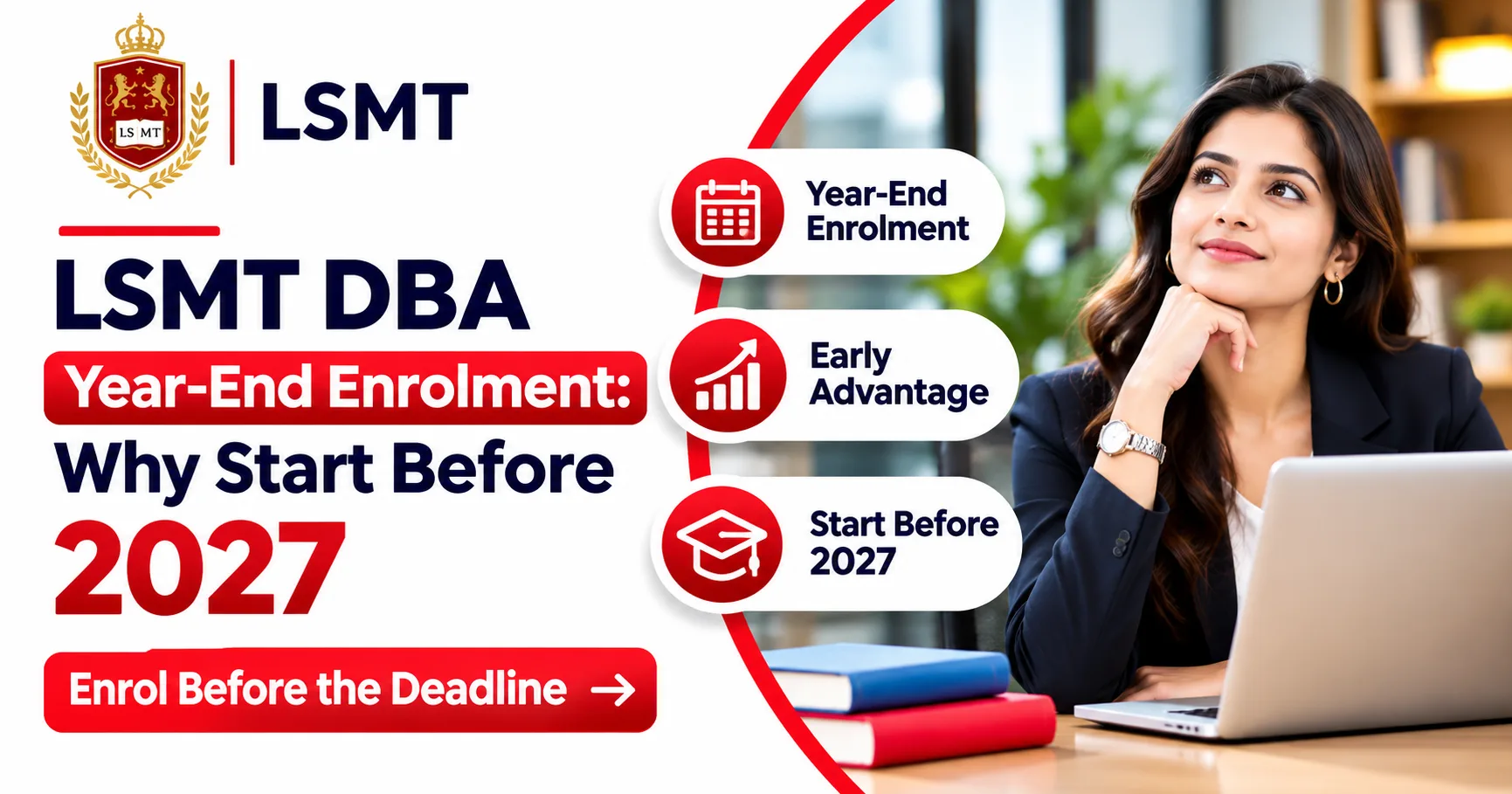
For experienced professionals, the end of 2026 can be a valuable opportunity to plan the next stage of their academic and professional journey. If you are considering a Doctor of Business Administration, starting the admission process before 2027 can help you prepare for doctoral-level learning, strengthen your management knowledge, and work towards long-term leadership goals.
The London School of Management and Technology LSMT offers an online Doctor of Business Administration programme designed for professionals, executives, entrepreneurs, consultants, and individuals interested in advanced business research.
The programme combines management education with research development and a doctoral dissertation. Its online learning format may appeal to candidates who want to continue working while pursuing higher education.
If you are planning to apply during the final months of 2026, it is important to understand the advertised admission deadline, eligibility requirements, curriculum, application process, and academic expectations before making a decision.
LSMT DBA Programme Overview
The LSMT DBA is a professional doctoral programme focused on advanced management knowledge, leadership development, and applied business research.
| Particulars | Details |
|---|---|
| Institution | London School of Management and Technology |
| Programme | Doctor of Business Administration |
| Study Mode | Online |
| Programme Duration | Typically 3 to 5 years, subject to progress |
| Eligibility | Recognised Master’s degree or equivalent |
| Minimum Academic Requirement | 55% or equivalent GPA of 2.0 on a 4.0 scale |
| Admission Process | Online application and interviews |
| Research Component | Research project and dissertation |
| Suitable For | Managers, executives, entrepreneurs and experienced professionals |
The programme is structured around management modules, research capability development, and dissertation work. Candidates should review the latest programme information and confirm the applicable academic requirements before applying.
Why Consider LSMT DBA Year-End Enrolment Before 2027?
Starting your application before the new year can help you organise your academic plans and prepare for the next available admission cycle. Here are some reasons why professionals may consider beginning the process in November or December 2026.
1. Take the First Step Towards Doctoral Education
Many working professionals postpone higher education because of professional responsibilities, business commitments, or uncertainty about selecting a programme.
Year-end planning gives you an opportunity to review your academic goals and take practical steps towards doctoral education. Instead of waiting until the beginning of 2027 to start researching programmes, you can use the remaining months of 2026 to understand the requirements and prepare your application.
LSMT’s programme information describes an online application process. Candidates should confirm the next available commencement date with the admissions team.
2. Study Online While Continuing Your Career
Leaving a full-time job to pursue a doctorate may not be practical for experienced professionals. An online DBA can offer greater flexibility by allowing candidates to access learning materials and manage their academic responsibilities alongside work.
LSMT promotes a flexible online learning format intended for busy professionals. This can be useful for managers, consultants, entrepreneurs, and business owners who need to balance professional and academic commitments.
However, online learning still requires discipline. Candidates should be prepared to complete assignments, participate in academic activities, and make consistent progress on their research.
3. Strengthen Strategic Management and Leadership Skills
Senior professionals regularly deal with complex decisions involving business growth, financial performance, organisational change, and leadership.
The LSMT DBA curriculum covers areas such as strategic management, leadership, business research, innovation, financial decision-making, and organisational behaviour.
Studying these subjects can help candidates examine management challenges through research and evidence-based approaches.
For example, a senior operations manager may explore strategies for improving organisational efficiency, while an entrepreneur may investigate innovation and business expansion.
4. Connect Professional Experience With Applied Research
One of the key reasons professionals consider a DBA is its practical research orientation.
Unlike programmes that focus mainly on theoretical management concepts, a DBA encourages candidates to investigate business problems and develop research-based insights that can be relevant to organisations.
LSMT includes research capability development and a research dissertation within its programme structure.
Candidates can explore topics related to their professional backgrounds, such as:
- Strategic leadership and organisational transformation
- Business innovation and entrepreneurship
- Digital transformation and technology management
- Financial decision-making
- Human resource management
- Marketing and consumer behaviour
- Corporate governance and business ethics
The research topic should be academically suitable and connected to a clearly defined business problem.
5. Prepare for Your 2027 Academic Goals
Applying before 2027 can give candidates additional time to organise documents, understand the admission process, and prepare for the programme.
This is particularly useful for professionals who need to arrange academic transcripts, verify qualifications, or discuss study commitments with their employers.
However, submitting an application before the new year does not automatically mean that classes will begin immediately. Candidates should confirm the actual commencement date and enrolment schedule.
LSMT DBA Curriculum and Programme Structure
The LSMT DBA combines management-related modules with research and dissertation activities. The published curriculum is organised across three academic years.
Year 1: Developing Research Capability
The initial stage focuses on building the research knowledge required for doctoral study.
One of the listed modules is Developing Research Capability. It introduces candidates to the skills needed to identify research questions, understand academic sources, and prepare for independent investigation.
This foundation is important because doctoral research requires a structured approach to analysing business challenges.
Year 2: Strategic Management and Business Development
The second stage includes subjects related to organisational development, strategic change, entrepreneurship, and global business.
Published curriculum modules include:
- Managing Strategic Change
- Entrepreneurship and Innovation
- Globalisation and Corporate Governance
These areas help candidates understand how organisations respond to changing markets, business risks, and emerging opportunities.
Year 3: Research and Dissertation
The final stage focuses on doctoral research and dissertation completion.
Candidates work towards developing and presenting a substantial research project based on an approved business or management topic.
The dissertation is an important part of the DBA because it demonstrates the candidate’s ability to investigate a business issue systematically and develop meaningful conclusions.
The actual time required to complete this stage may depend on research progress and the institution’s academic requirements.
LSMT DBA Eligibility Criteria for 2026 Admission
Before applying for year-end enrolment, candidates should check whether their academic qualifications meet LSMT’s published admission requirements.
The programme page states that applicants should generally have:
- A recognised Master’s degree or an equivalent full qualification at EQF Level 7.
- A minimum overall score of 55% or equivalent GPA of 2.0 on a 4.0 scale.
- Academic qualifications that meet the institution’s equivalency requirements.
Candidates should also be prepared to provide supporting academic documents and personal essays.
If your previous qualification was obtained outside the institution’s usual academic framework, contact the admissions team to confirm whether it meets the required equivalency standard.
LSMT DBA Admission Process Before 2027
The admission process involves several stages. Applicants should complete each step carefully and provide accurate information.
Step 1: Submit the Online Application
Complete the application form with your personal, academic, and professional details. Make sure all information matches your supporting documents.
Step 2: Upload Required Documents and Essays
Submit the academic documents and personal essays requested by the institution. These materials help the admissions team understand your educational background and motivation for doctoral study.
Step 3: Application Review and Shortlisting
The admissions committee reviews applications to assess the candidate’s academic suitability and overall profile.
Step 4: Attend the Interview Rounds
LSMT’s published admission process states that shortlisted candidates may be invited for two rounds of individual interviews.
These discussions help the institution evaluate the applicant’s suitability for the programme.
Step 5: Receive the Admission Decision
The final decision is based on the overall application assessment and interview performance.
Step 6: Complete Enrolment Formalities
Candidates who receive an offer should follow the official instructions for completing enrolment and preparing for the programme.
Documents Required for LSMT DBA Admission
Preparing your documents in advance can help make the application process more organised.
Commonly requested documents include:
- Master’s degree certificate
- Academic transcripts
- Bachelor’s degree documents, where requested
- Updated CV or professional resume
- Valid passport or government-issued identity document
- Personal essays or statement of purpose
- English language proficiency evidence, if applicable
- Additional documents requested by the admissions committee
Applicants should confirm the latest document checklist directly with LSMT because requirements may vary according to academic background.
Important Things to Check Before the November 2026 Deadline
The LSMT DBA listing on eCampusApp advertises November 30, 2026, as the admission deadline. Since this date is approaching, interested candidates should verify whether applications are still being accepted and whether the deadline applies to their intended intake.
Before making a decision, review these important points:
Confirm the next intake: Ask the admissions team about the next academic commencement date and whether your application can be processed before the end of 2026.
Verify the programme duration: The curriculum is presented across three academic years, while the programme FAQ describes a typical completion period of three to five years. Confirm the applicable minimum and maximum completion period.
Understand the accreditation details: Review the institution’s current accreditation status and the exact scope of each accreditation. Do not assume that an accreditation consideration or group-level review means the DBA itself has received programme accreditation.
Check the awarding arrangements: Confirm the institution responsible for awarding the final qualification and the exact title of the degree.
Review recognition for your career plans: If you intend to use the qualification in India, check its acceptance for your intended employment, academic, or further-study purpose before enrolling.
Who Should Consider the LSMT DBA?
The programme may be relevant to several categories of experienced professionals.
Senior managers and executives: Professionals who want to strengthen their strategic thinking and leadership capabilities may consider doctoral-level management education.
Entrepreneurs and business owners: Business owners interested in researching innovation, organisational growth, and business strategy may find the applied research approach relevant.
Management consultants: Consultants can explore research topics related to organisational performance, business transformation, and strategic decision-making.
Academics and researchers: Eligible candidates interested in advanced business research and contributing to management knowledge may also consider the programme.
Mid-career professionals: Experienced individuals looking to develop specialised management knowledge can explore the programme if they meet the academic requirements.
Conclusion
LSMT DBA year-end enrolment can be an opportunity for eligible professionals to prepare for doctoral education before 2027. The online format, management-focused curriculum, research development, and dissertation component make the programme relevant to candidates interested in connecting professional experience with advanced business research.
However, applicants should not make an admission decision based only on a year-end deadline. It is important to verify eligibility, understand the interview process, review accreditation and awarding details, and confirm the next academic commencement date.
For professionals with clear academic and career objectives, beginning the application process in November 2026 can be a practical step towards planning their doctoral journey in 2027.
Frequently Asked Questions
1. Is LSMT DBA admission open before 2027?
The LSMT DBA listing on eCampusApp advertises November 30, 2026, as the admission deadline. Candidates should confirm the current application status and next available intake directly with the institution.
2. What is the duration of the LSMT DBA programme?
The curriculum is structured across three academic years. LSMT’s programme FAQ describes a typical completion period of three to five years, depending on the candidate’s progress.
3. Can working professionals pursue the LSMT DBA online?
Yes. LSMT offers an online DBA format designed for professionals who want to continue working while pursuing doctoral education.
4. What is the eligibility for LSMT DBA admission?
Applicants generally need a recognised Master’s degree or equivalent EQF Level 7 qualification with at least 55% overall marks or an equivalent GPA of 2.0 on a 4.0 scale.
5. Does LSMT conduct interviews for DBA admission?
Yes. According to its published admission process, shortlisted applicants may be invited for two rounds of individual interviews before the final decision.
6. What subjects are included in the LSMT DBA curriculum?
The published curriculum includes research capability development, strategic change management, entrepreneurship and innovation, globalisation, corporate governance, and research and dissertation work.
7. Does the LSMT DBA include a dissertation?
Yes. Research and dissertation work form an important part of the final stage of the programme. Candidates are expected to complete doctoral research according to the institution’s academic requirements.
8. Is GMAT or GRE required for LSMT DBA admission?
The published programme admission information does not list GMAT or GRE as a standard requirement. Applicants should confirm whether any additional assessment applies to their individual application.
9. Can Indian professionals apply for the LSMT DBA?
Indian professionals can enquire about admission if they meet the published academic requirements. They should also verify the qualification’s recognition and suitability for their intended career in India before enrolling.
10. What should I check before enrolling in the LSMT DBA?
Review the admission deadline, eligibility, curriculum, duration, interview process, accreditation details, awarding arrangements, and recognition relevant to your career objectives before completing enrolment.