Healthcare administration is becoming increasingly complex. Hospitals, diagnostic centres, healthcare networks, pharmaceutical companies, and other medical organisations must manage rising operational costs, digital transformation, patient expectations, workforce challenges, and regulatory responsibilities.
For professionals working in these environments, developing strong business management and research skills can be valuable. A Doctorate in Business Administration is one route to building advanced knowledge in leadership, strategic decision-making, organisational development, and applied research.
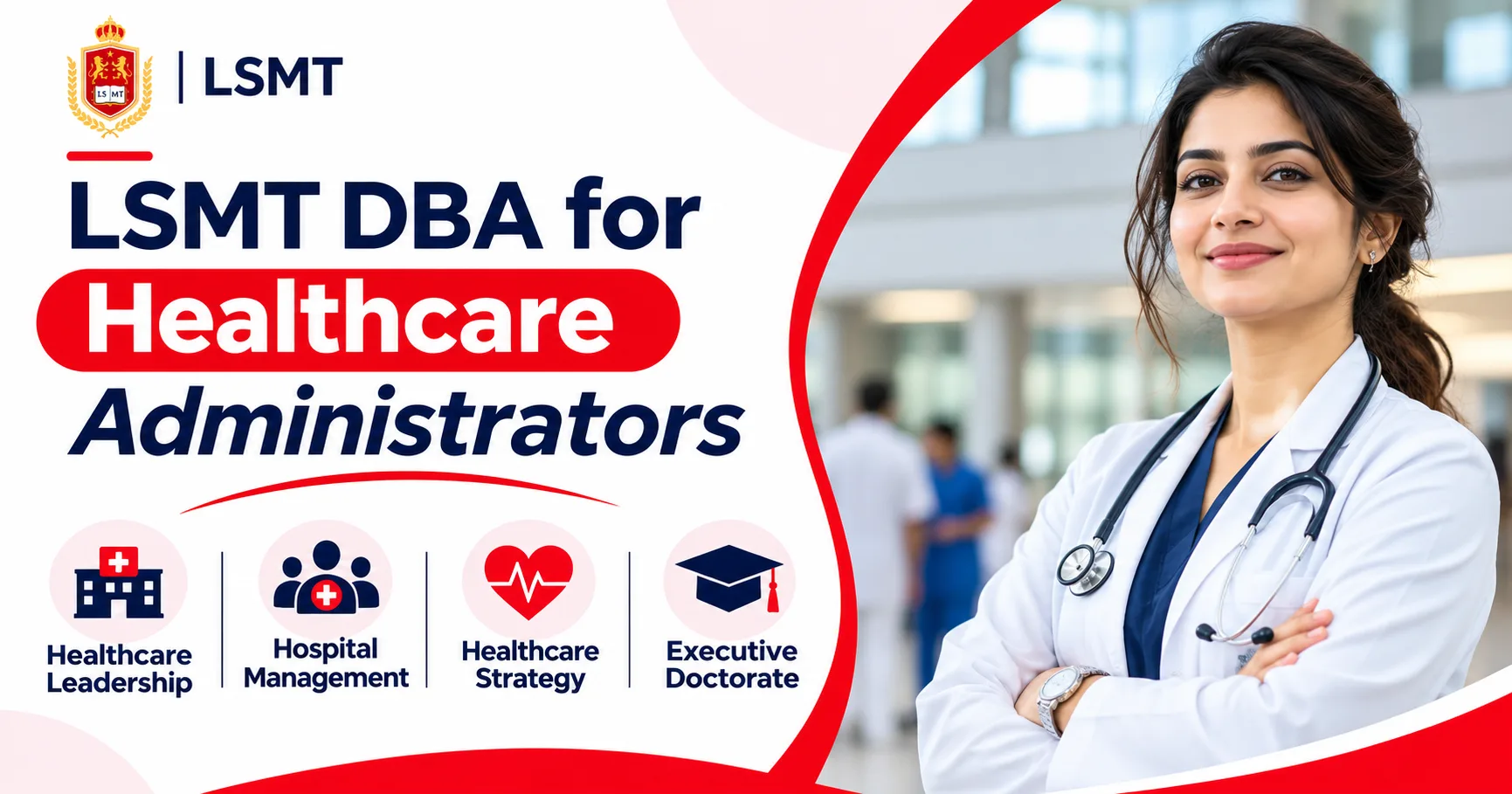
The London School of Management and Technology, commonly known as LSMT, offers an online Doctorate in Business Administration designed for experienced professionals and executives. Although the programme is not presented as a dedicated healthcare administration doctorate, healthcare administrators may explore it if they want to research management challenges within the healthcare industry.
This guide explains the programme structure, eligibility, curriculum, possible healthcare research areas, career opportunities, and important recognition considerations for Indian professionals in 2026.
LSMT DBA Programme Overview
The LSMT DBA is an online professional doctorate focused on business management, strategic leadership, and applied research. Its general management curriculum may be relevant to healthcare administrators who want to investigate organisational challenges and develop evidence-based management solutions.
| Programme Details | Information |
|---|---|
| Institution | London School of Management and Technology |
| Programme | Doctorate in Business Administration |
| Short Name | DBA |
| Study Mode | Online |
| Published Duration | Three years |
| Programme Focus | Business management, leadership and applied research |
| Research Component | Research and dissertation |
| Suitable Applicants | Experienced professionals, executives and managers |
| Healthcare Specialisation | Not separately listed on the published DBA page |
The programme is positioned for senior professionals who want to improve their management capabilities and conduct research related to practical business challenges. Healthcare administrators should confirm with the institution whether their proposed healthcare research topic can be supported by an appropriate supervisor.
Why Should Healthcare Administrators Consider an LSMT DBA?
Healthcare organisations require more than medical expertise to operate successfully. They also need professionals who understand financial planning, workforce management, operational efficiency, organisational leadership, and long-term strategy.
A DBA may help healthcare administrators approach these responsibilities through structured research and advanced management concepts.
1. Develop Strategic Healthcare Leadership
Healthcare administrators frequently make decisions involving hospital expansion, service delivery, infrastructure, staffing, and organisational performance.
A DBA can help professionals strengthen their understanding of strategic management and leadership. These capabilities may be useful when managing large healthcare facilities, multiple departments, or healthcare networks.
2. Improve Hospital and Healthcare Operations
Operational efficiency directly affects how healthcare organisations deliver services.
Administrators may investigate challenges such as patient waiting times, appointment scheduling, resource allocation, inventory management, and coordination between departments.
Research-based management approaches can help identify operational problems and evaluate possible improvements.
3. Understand Healthcare Financial Management
Financial planning is an important responsibility in hospitals and healthcare businesses.
Healthcare administrators may need to manage operating budgets, equipment investments, procurement expenses, revenue cycles, and long-term financial sustainability.
The DBA’s broader business management and financial decision-making content can provide a foundation for researching these challenges.
4. Support Digital Transformation in Healthcare
Digital technologies are changing how healthcare organisations manage information and deliver services.
Hospital management systems, electronic health records, telemedicine, artificial intelligence, and data analytics are creating new administrative opportunities and challenges.
Healthcare leaders with research and strategic management skills may be better prepared to evaluate technology investments and organisational readiness.
5. Strengthen Research and Decision-Making Skills
Healthcare administrators often work with complex organisational information. Research skills can help them evaluate problems, understand evidence, compare management approaches, and develop practical recommendations.
The DBA’s research and dissertation component is particularly relevant to professionals who want to investigate a specific management issue within their organisation.
LSMT DBA Curriculum and Subjects
LSMT’s published DBA curriculum includes research capability, strategic change management, and a research dissertation. Its programme information also describes broader learning areas such as strategic management, leadership, financial decision-making, innovation, organisational behaviour, and business research methods.
The curriculum is business-oriented rather than exclusively healthcare-focused.
| Study Stage | Published Curriculum Area | Relevance to Healthcare Administration |
|---|---|---|
| Year 1 | Developing Research Capability | Understanding healthcare management research |
| Year 2 | Managing Strategic Change | Managing hospital transformation and organisational change |
| Year 3 | Research and Dissertation | Investigating a healthcare administration challenge |
The institution’s programme page displays these three broad curriculum stages. Applicants should request the complete current module list and assessment structure before enrolment because the detailed curriculum should be confirmed for the relevant intake.
Important Management Areas for Healthcare Professionals
The following broader learning areas described by LSMT may be relevant to healthcare management:
Strategic Management: Understanding organisational goals, long-term planning, competitive positioning, and institutional growth.
Leadership: Developing decision-making, communication, and leadership capabilities for complex organisations.
Financial Decision-Making: Understanding financial planning, investment decisions, and organisational resource management.
Innovation and Change Management: Evaluating new technologies, improving processes, and managing organisational transformation.
Business Research Methods: Learning how to investigate management problems and develop evidence-based recommendations.
Healthcare Research Topics for an LSMT DBA
One of the most important parts of a DBA is the research project. Healthcare administrators can explore management-related topics that connect their professional experience with wider industry challenges.
The proposed research topic should be discussed with the institution before admission to confirm its suitability and the availability of relevant supervision.
| Research Area | Possible DBA Research Topic |
|---|---|
| Hospital Operations | Improving operational efficiency in multi-speciality hospitals |
| Patient Experience | The impact of service quality on patient satisfaction |
| Healthcare Finance | Financial sustainability strategies for private hospitals |
| Human Resource Management | Reducing employee turnover among healthcare professionals |
| Digital Healthcare | The role of digital transformation in hospital administration |
| Healthcare Supply Chain | Improving medical inventory and procurement management |
| Leadership | The impact of leadership styles on hospital performance |
| Telemedicine | Organisational challenges in adopting telehealth services |
| Quality Management | Management strategies for improving healthcare service quality |
| Healthcare Strategy | Strategic planning for the expansion of healthcare networks |
A strong research proposal should identify a specific management problem, explain why it matters, and describe how the research could contribute to better organisational practices.
Who Should Consider the LSMT DBA?
The programme may be relevant to professionals who have experience managing healthcare organisations or business functions within the medical sector.
Hospital Administrators
Hospital administrators oversee administrative operations, departmental coordination, staffing, budgets, and service delivery. A DBA research project may help them investigate organisational performance and hospital management strategies.
Healthcare Operations Managers
Operations managers focus on improving processes, resource utilisation, procurement, and service efficiency. They may explore research topics related to hospital workflow, operational performance, and supply chain management.
Healthcare Business Development Managers
Professionals responsible for healthcare expansion, partnerships, and business growth may use management research to understand market development and strategic planning.
Medical Practice and Clinic Managers
Clinic managers handle daily administration, scheduling, patient services, staff coordination, and financial activities. Research into service quality and operational efficiency may be relevant to their responsibilities.
Healthcare Entrepreneurs
Founders and owners of healthcare businesses may explore organisational growth, innovation, financial sustainability, and technology adoption through applied business research.
Senior Healthcare Executives
Chief operating officers, hospital directors, healthcare consultants, and senior management professionals may consider the programme if they want to strengthen their research and strategic management capabilities.
LSMT DBA Eligibility Criteria
According to the published LSMT DBA eligibility information, applicants should hold a recognised master’s degree or an equivalent EQF Level 7 full qualification.
The stated minimum academic requirement is 55% overall or a GPA of 2.0 on a 4.0-point scale.
| Eligibility Requirement | Published Information |
|---|---|
| Academic Qualification | Recognised master’s degree or equivalent EQF Level 7 qualification |
| Minimum Marks | 55% overall |
| GPA Alternative | 2.0 on a 4.0 scale |
| Professional Background | Relevant experience is useful for a practice-focused DBA |
| Application | Online application and supporting documents |
| Selection | Application review and possible interview |
Healthcare administrators should confirm whether their master’s qualification meets the institution’s equivalency requirements. Applicants with healthcare administration, hospital management, public health management, MBA, or other relevant postgraduate backgrounds can ask the admissions team for an individual eligibility assessment.
Documents Required for Admission
Applicants may be asked to provide:
- Updated professional CV or resume
- Bachelor’s degree certificate and transcripts
- Master’s degree certificate and transcripts
- Identity document or passport
- Statement of purpose
- Professional experience details
- Research interest statement or proposal
- Recommendation letters, if requested
The final document list should be confirmed with the admissions department.
LSMT DBA Learning Format
The LSMT DBA is advertised as an online programme, which may appeal to healthcare administrators who want to continue working while pursuing advanced studies.
Healthcare professionals often have demanding schedules involving hospital operations, staff management, meetings, and administrative responsibilities. Online study can provide greater flexibility than a conventional full-time campus programme.
The institution describes its online learning approach as including access to programme materials, digital learning resources, online academic engagement, and research support.
Before enrolment, applicants should confirm:
- Whether lectures are live, recorded, or self-paced
- The expected weekly study commitment
- Research supervision arrangements
- Dissertation submission milestones
- Assessment and examination requirements
- Access to academic resources
- Whether any mandatory campus visits or additional activities apply
These details can help healthcare administrators decide whether they can manage the programme alongside their professional responsibilities.
Career Opportunities After an LSMT DBA
A DBA is primarily a doctoral-level management and research qualification. It does not provide a medical licence or replace professional healthcare qualifications.
For experienced administrators, the knowledge gained through doctoral research may support career development in management, consulting, organisational leadership, and research-oriented roles.
| Career Path | Relevant Responsibilities |
|---|---|
| Hospital Director | Overseeing hospital strategy and administration |
| Healthcare Operations Head | Managing service delivery and operational performance |
| Healthcare Consultant | Advising organisations on management and business challenges |
| Healthcare Business Strategist | Planning growth, partnerships, and organisational development |
| Healthcare Project Director | Managing healthcare expansion and transformation projects |
| Hospital Administration Researcher | Investigating organisational and management challenges |
| Healthcare Entrepreneur | Developing and managing healthcare businesses |
| Corporate Healthcare Executive | Leading business functions in healthcare companies |
Career progression depends on previous experience, professional qualifications, organisational requirements, and the value employers place on the particular DBA award.
A DBA alone does not guarantee a director-level appointment or academic employment.
Accreditation and Recognition: What Indian Applicants Should Check
This is an especially important consideration for Indian professionals thinking about an international online DBA.
LSMT’s published accreditation information describes its relationship with the Accreditation Council for Business Schools and Programs, or ACBSP, as part of a group-level accreditation review. It states that the Euro American Education Group has been accepted for consideration through the ACBSP process and that LSMT is included within the defined scope of that review.
The same institutional information identifies QAHE accreditation for LSMT. These credentials should be understood according to their respective scope and status. ACBSP group-level consideration should not be described as completed programme accreditation.
More importantly, LSMT’s own accreditation and membership page makes a distinction between its private institutional programmes and qualifications awarded by recognised degree-awarding institutions. It states that LSMT does not claim to be a UK university or a UK-recognised degree-awarding body unless such status is separately granted.
Therefore, Indian applicants should obtain written confirmation of the following before enrolling:
- The exact legal name of the institution awarding the DBA.
- Whether the award is an LSMT institutional qualification or issued by another awarding institution.
- The applicable accreditation and regulatory status of that awarding institution.
- The exact qualification title that will appear on the certificate and transcript.
- Whether the qualification is acceptable for the intended employment or further-study purpose in India.
A foreign professional doctorate should not automatically be treated as equivalent to a PhD awarded by an Indian university. Applicants seeking academic positions, public-sector employment, or further research opportunities should verify the applicable recognition requirements independently.
Is the LSMT DBA Worth It for Healthcare Administrators?
The LSMT DBA may be worth exploring for healthcare administrators who want to study business management, leadership, strategic change, and applied research through an online format.
Its general management orientation may allow experienced healthcare professionals to investigate topics such as hospital efficiency, patient experience, healthcare finance, digital transformation, and organisational leadership.
However, the programme should not be selected on the assumption that it provides a dedicated healthcare administration specialisation. Its published DBA curriculum is broader and focused on business administration.
The recognition and awarding-institution details also require careful verification. This is particularly important for Indian applicants who intend to use the qualification for academic employment, regulated professional purposes, or further study.
A sensible decision should consider three factors: whether the curriculum supports your research interests, whether the online format fits your working schedule, and whether the exact award meets your long-term professional requirements.
Conclusion
Healthcare administrators need a combination of operational knowledge, strategic leadership, financial understanding, and research capabilities to manage modern healthcare organisations. A Doctorate in Business Administration can provide a structured opportunity to explore these management challenges at an advanced level.
The LSMT DBA offers an online, business-focused doctoral pathway that may be relevant to hospital administrators, healthcare operations managers, clinic managers, and healthcare entrepreneurs. Its broad management and research areas can provide a foundation for investigating healthcare-related organisational problems.
However, it is important to remember that the programme is not listed as a specialised healthcare DBA. Applicants should confirm research supervision, the complete curriculum, the exact awarding institution, and recognition requirements before making an enrolment decision.
Frequently Asked Questions
1. Is the LSMT DBA suitable for healthcare administrators?
It may be suitable for experienced healthcare administrators interested in business management, leadership, organisational change, and applied research. However, it is a general DBA rather than a dedicated healthcare administration doctorate.
2. Does LSMT offer a healthcare management specialisation?
The published standalone DBA curriculum does not list a separate healthcare management specialisation. Applicants should ask whether healthcare-related dissertation topics can be supported.
3. Can hospital administrators apply for the LSMT DBA?
Hospital administrators with the required recognised master’s qualification may apply. Their professional experience and proposed research interests can be discussed during the admissions process.
4. What is the duration of the LSMT DBA?
LSMT presents its standalone DBA as a three-year programme. Applicants should confirm the expected completion timeline and any applicable extension rules for their intake.
5. Is the LSMT DBA available online?
Yes. The programme is advertised in an online format, making it an option to explore for professionals who want to continue working while studying.
6. What is the minimum qualification required for admission?
The published eligibility requirement is a recognised master’s degree or equivalent EQF Level 7 qualification, with a minimum overall score of 55% or GPA 2.0 on a 4.0 scale.
7. Can a hospital operations manager pursue this DBA?
Yes, provided the applicant meets the academic eligibility requirements. Hospital operations, resource utilisation, procurement, and service efficiency may offer relevant management research areas.
8. Can I research hospital management during the DBA?
Healthcare management may be a potential research area because the DBA focuses on applied business research. Applicants should obtain approval for their proposed topic and confirm the availability of suitable supervision.
9. What subjects are covered in the LSMT DBA?
Published programme information identifies developing research capability, managing strategic change, and research and dissertation. It also describes broader management areas such as leadership, financial decision-making, innovation, and business research.
10. Can healthcare entrepreneurs apply for the LSMT DBA?
Yes. Healthcare entrepreneurs who meet the academic requirements may explore research related to business growth, healthcare innovation, financial sustainability, and organisational strategy.
11. Does the LSMT DBA qualify someone to become a doctor?
The DBA is a doctoral-level business qualification, not a medical degree. It does not qualify graduates to practise medicine or provide clinical services.
12. Is the LSMT DBA recognised in India?
Applicants should not assume automatic recognition. LSMT states that its own private institutional awards are distinct from statutory UK degrees and qualifications awarded by recognised UK degree-awarding bodies. Indian applicants should verify the exact awarding institution and the qualification’s acceptance for their intended purpose.
13. Can I pursue the LSMT DBA while working full-time in a hospital?
The online format may offer flexibility, but the actual workload, live sessions, research milestones, and supervision schedule should be confirmed before admission.
14. What career opportunities can follow an LSMT DBA for healthcare professionals?
Depending on previous experience and employer requirements, the research and management skills developed may be relevant to hospital leadership, healthcare consulting, operations management, business strategy, and research-oriented roles.
15. Should healthcare administrators choose a specialised healthcare DBA instead?
Professionals whose main objective is to study hospital administration, public health management, or healthcare policy in depth may prefer to compare specialised healthcare doctorates with a general DBA. The best choice depends on the research topic, awarding institution, curriculum, and intended career outcome.